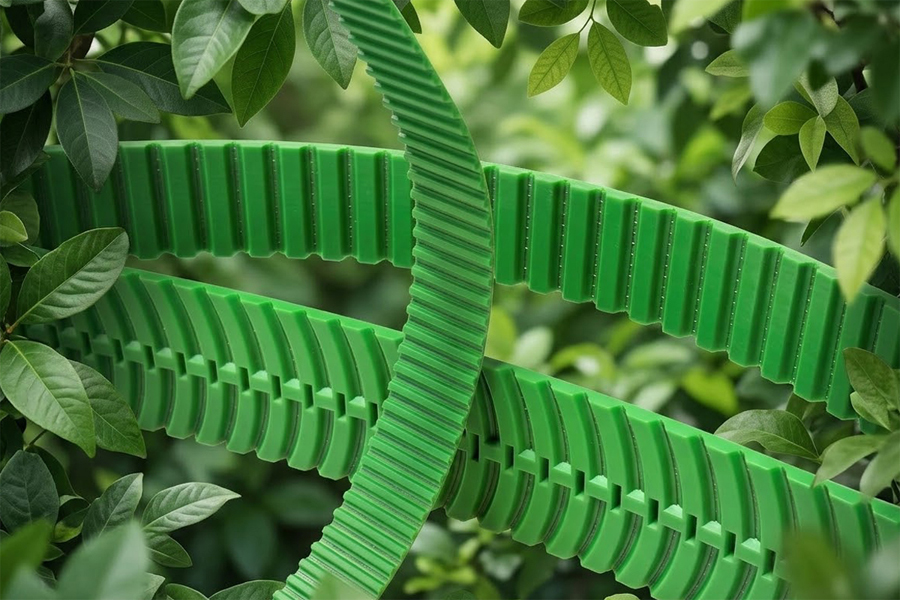
ALZMETALL relies on SYNCHROFLEX® GEN III
Decisive factors: High positioning precision and attractive cost factor

Machining Centre GS 1000 from ALZMETALL.
In more than six decades, ALZMETALL GmbH in Altenmarkt / Chiemgau has become one of the leading companies in drilling, milling and casting technologies. More than 170,000 machines supplied world wide to machine manufacturers, the automotive industry, and tool and mould manufacturers are a convincing fact. For the drives in their machining centres GS (gantry system), FS (travelling column) as well as CS (rigid column concept in “C” design) the Bavaria based machine manufacturer counts on Mulco’s polyurethane timing belts and pulleys. „The polyurethane timing belt Synchroflex® GEN III with its excellent abrasion resistance paired with increased stiffness, its notably lower stretch in an identical constructional space and a power transmission increased by up to 25 % is absolutely convincing“, says Josef Sturm of the consulting company Nürnberger Roth GmbH + Co. KG, one of Mulco’s 15 partner companies. 
SYNCHROFLEX GEN III drive of the tool chain magazine.
The ALZMETALL machining centre GS 1000 uses a SYNCHROFLEX GEN III 32 ATP10/1150 of 1150 mm length and 32 mm width to drive the tool chain magazine. It ensures precise application of the tool chain, equipped with 33 tools in its basic version. The twin-chain version of the GS 1000 can hold up to 150 tools. The forces to be transmitted by GEN III become apparent, given the maximum possible weight per tool of 10 kg. The tool change can be performed in an amazing 2 seconds thanks to the high-performance SYNCHROFLEX GEN III. FEM optimises machine behaviour

Twin-chain tool magazine in the GS 1000 machining centre.
„Our machines convince by their high dynamics and their machine structure offering an extremely good vibration behaviour“, explains the manager of the Development and Design department of ALZMETALL, Dipl. Eng. (FH) Ludwig Probst, by the example of the GS 1000 machining centre, referring to the development of the Finite-Elements Method. The simulation of the vibration behaviour of the machine in relation to its dynamic rigidity permits an optimum concept of the machine behaviour. The machine body is produced in the company’s own foundry. Grey cast is used for the structure components subject to static load, whereas nodular cast iron is preferred for dynamically stressed components. The closed gantry structure ensures a closed-loop load transmission between workpiece and tool. The quadruple guide systems of the X and Y axis of the coordinate travel gear arranged inside the end plates generate a rigidity that reaches double the value of top mounted travel gears. The result is a clearly longer tool operating life. High positioning precision, attractive cost factor
Prior to SYNCHROFLEX GEN III having demonstrated its convincing potential in the ALZMETALL GS series, experiments were carried out with cycle drives, explained Mr. Probst, manager of the Design Department. However, it was not long before today’s own design with polyurethane timing belts and pulleys from the Mulco range was developed. “The high positioning precision and the favourable cost factor are unrivalled”, adds Probst.Despite its compact design, featuring a width of 2250 mm, a depth of 4759 mm and a height of 3400 mm, as well as a weight of 15,500 kg, the GS series offers a large dimensioned chip removal area of Ø 1070 mm around the C axis and Ø 980 mm around the A axis. These machining centres are used for high-speed, hard and dry machining of components for the most varied industries.
Hanover, April 2007
Mulco-Europe EWIV